

What is Holly’s Law?
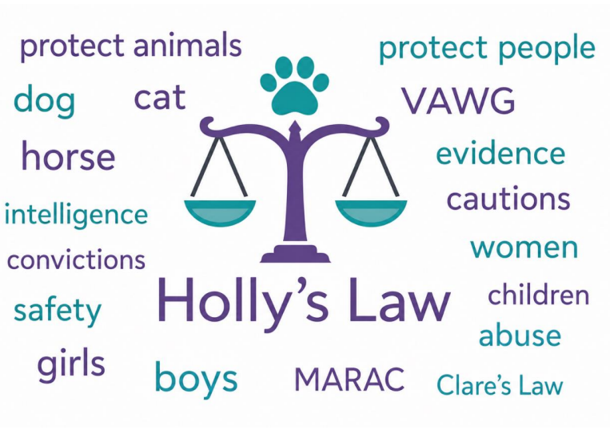
What is Holly’s Law?
Holly's Law is named after Holly Bramley, a 26-year-old woman who was murdered by her husband. He had a documented history of violence towards animals and of harming Holly's pets before he killed her.
Her mother, Annette Bramley, has led the campaign since Holly's death, alongside Catherine Haworth from Avon & Somerset Family Law. The campaign, backed by Naturewatch Foundation, and a version of which was supported by a public petition that attracted over 238,000 signatures, calls for an Animal Protection Disclosure Scheme modelled on Clare's Law.
In March 2023, 26-year-old Holly Bramley was tragically murdered by her partner after suffering violence and coercive control. During their relationship, Holly’s beloved pets were also abused and finally killed.
Evolution of Holly’s Law
Holly’s Law recognises that harm to animals can be a significant indicator of wider abuse, coercion and violence, and that animal welfare intelligence must be considered alongside other safeguarding information if risks are to be properly assessed and managed.
When the right people have access to the best available intelligence, proactive disclosures can be made to protect both animals and people.
Holly’s Law started as a petition and campaign for a public animal abuse register, but when Catherine joined the campaign, it has taken a new direction and instead now calls for proportionate disclosure under the Animal Abuse Disclosure Scheme. Akin to Clare’s Law (Domestic Violence Disclosure Scheme), Holly’s Law would allow the police to disclose details of relevant animal related offending to potential victims of domestic abuse, allowing them to make an informed decision as to whether to enter a relationship.
What have we achieved so far?
In April 2026, Catherine attended parliament with Annette who met with the then minister Jess Phillips and Home Secretary Chris Philp, along Sir John Hayes MP to discuss Holly’s Law. It was here that promises were made to review Statutory Guidance in Domestic Abuse and Controlling and Coercive Behaviour to include references to animal abuse as a tool for coercive control.
Then on 10th June 2026, Catherine Haworth convened a roundtable at Parliament consisting of Annette, and Holly’s family, Home Office officials, DEFRA officials, MP’s form labour, conservative and liberal democrat parties, Naturewatch Foundation, RSPCA, Safelives, Animal Welfare Organisations and Safeguarding Specialists, to discuss the wider aims of Holly’s Law and the practical implementation of the Animal Protection Disclosure Scheme.
Since this date, Holly’s Law has featured across parliamentary debates – most notably the debate that took place on the 29th June – and MP’s have raised various concerns in parliament relating to the link between abuse of people and abuse of pets.
Catherine along with Mark Randell, Naturewatch Foundation, have been in regular contact with Home Office officials about the development of revised Statutory Guidance on Domestic Abuse and Coercive Control as well as the implementation of the Animal Protection Disclosure Scheme.
Catherine, Annette and Mark, will be attending the “Shaping Better Responses to Domestic Abuse” at Scotland Yard later in October as well as the APDAWG event at Parliament to talk about Holly’s Law.
Our aims
Holly’s Law continues to grow and evolve every day. Our current aims are to:
- Introduce a proportionate disclosure scheme for animal related offences, like Clare’s Law or Sarah’s Law.
- Improve police training on the link between abuse of animals and abuse of people, in particular reviewing the classification of animal related offences as “criminal damage” which may not be disclosed to a victim.
- Call for better information sharing between the RSPCA and police.
How you can help
We would love your help with our campaign! To find out how to get involved, please contact us at enquiries@haworthfamilylaw.co.uk or visit www.haworthfamilylaw.co.uk where you can find a template letter to your MP.
We are also asking people who support the campaign to put together a short paragraph or few sentences outlining their support and to be added to our “Holly’s 100” – these can also be e-mailed to Catherine at the above address.